
Clay County City Directory Collections
The verified Liberty titles are useful checkpoints, not proof of a complete annual series. Midwest Genealogy Center catalog results identify R.L. Polk & Co.'s Liberty, Missouri city directory: also included, Clay County rural residents for 1975 and 1983. A separate St. Louis County Library list verifies a Liberty print entry for 1988. The Polk title matters because its scope reaches beyond Liberty proper into rural Clay County, which can make the volume a stronger county-family lead than its title suggests.
| Directory collection | Verified year or range | Repository | How to use it |
|---|---|---|---|
| Liberty, Missouri city directory: also included, Clay County rural residents, R.L. Polk & Co. | 1975 | Midwest Genealogy Center catalog | Catalog and physical-volume research |
| Same Polk title | 1983 | Midwest Genealogy Center catalog | Catalog and physical-volume research |
| Liberty print listing | 1988 | St. Louis County Library list | Ask at the reference desk |
| Missouri city, county, state, and telephone directories | Years not fully transcribed | Midwest Genealogy Center microform guides | On-site guide and microform inspection |
Missouri Digital Heritage describes directories as yearly alphabetical books that often include addresses and occupations, and searchable digital text can support name, address, occupation, or date searching. Its hosted examples are strongest for Hannibal and St. Louis. No Clay or Liberty digitized run was verified there, so it is a good explanation of the format rather than a promised online local volume.
Note: A missing catalog result does not establish that no Clay County volume exists; microform holding guides can list material not yet cataloged online.
Verified Liberty City Directory Years
Use 1975, 1983, and 1988 as documented check points. The years between them, earlier Polk titles, and a final publication year were not verified in the official sources reviewed. That limit is worth keeping in the research notes. A request for a particular year should name the household, Liberty or rural Clay County scope, and the preferred format, print, microfilm, or scan, instead of assuming a full shelf exists.
For a missing year, start at the Midwest Genealogy Center catalog and then ask staff to consult the Missouri and U.S./foreign directory guides. Clay County Archives, the Library of Congress, and the FamilySearch catalog are sensible next repositories for a particular title or a nearby year. Interlibrary loan may be possible through MGC, although the lending institution can charge.
Midwest Genealogy Center's materials collections explain the split between cataloged print directories and microfiche or microfilm that must be checked in the holding guides.
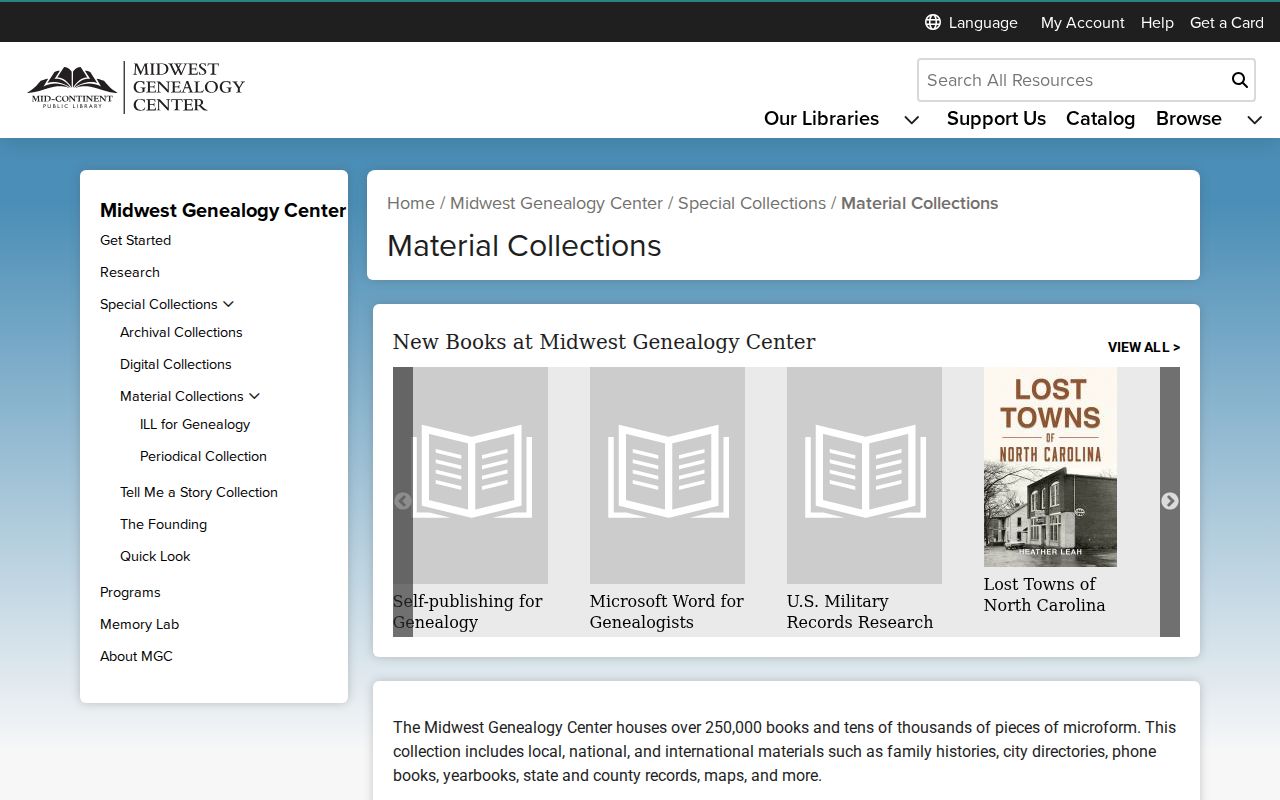
The collections view reinforces why a Clay County collection search can expand to phone books, yearbooks, maps, and microform when one printed volume has a gap.
Clay County Directory Microform Leads
Midwest Genealogy Center is at 3440 S. Lee's Summit Road in Independence. On-site research and research assistance do not require a library pass, although many online databases do require a card. The center lists Sunday hours of 1 to 8 and Monday through Saturday hours of 10 to 8. Its holdings include city directories, telephone books, yearbooks, maps, county and state records, rare books, periodicals, family histories, and tens of thousands of microform pieces.
A criss-cross directory is the address-ordered part of a volume, when one exists. It can point from a street number to a listed household. A householder index is an alphabetical route to the main listing. An abbreviation key explains the book's own shorthand. No verified Clay or Liberty criss-cross run, sample page, or abbreviation key was located, so check the front matter and preserve the printed abbreviations before interpreting them.
- Criss-cross directory
- An address-first arrangement that may connect a street number to a listed household.
- Householder index
- An alphabetical finding aid that directs a reader to a household listing or section.
- Abbreviation key
- The volume's own explanation of shortened words and symbols, usually near the beginning or end of the book.
Note: Telephone books can bridge later years, but they may omit people without listed service and may describe households differently from a printed volume.
How a Clay County City Directory Reads
No open 1975 or 1983 Liberty page was available for direct inspection. A safe transcription begins with what the physical line actually says. Copy the name, address with number, direction, and suffix, the occupation or business text if printed, any cross-reference symbol, and every abbreviation. Do not expand a mark into a personal or household-status statement unless that specific volume's key confirms it.
| Name line | Record spelling, initials, suffixes, and any alternate form exactly as printed. |
|---|---|
| Street address | Keep the number, direction, street name, and suffix so a later map or parcel search can test the location. |
| Occupation or business | Use it as a historical distinguishing detail, not as proof of a current connection. |
| Cross-reference | Copy any printed cross-reference or symbol and look for its explanation in the same volume. |
| Year-to-year change | Mark moves, spelling changes, and appearances or disappearances without guessing why they occurred. |
Compare one entry with the adjacent alphabetical and street sections where available. A listed name may be a person, a business, or an address-related entry. The original page, not a typed recollection, remains the best record of what the directory says.
Missouri Digital Heritage's directory overview explains the kinds of details that directory books may contain and the search approaches available in its digitized collections.
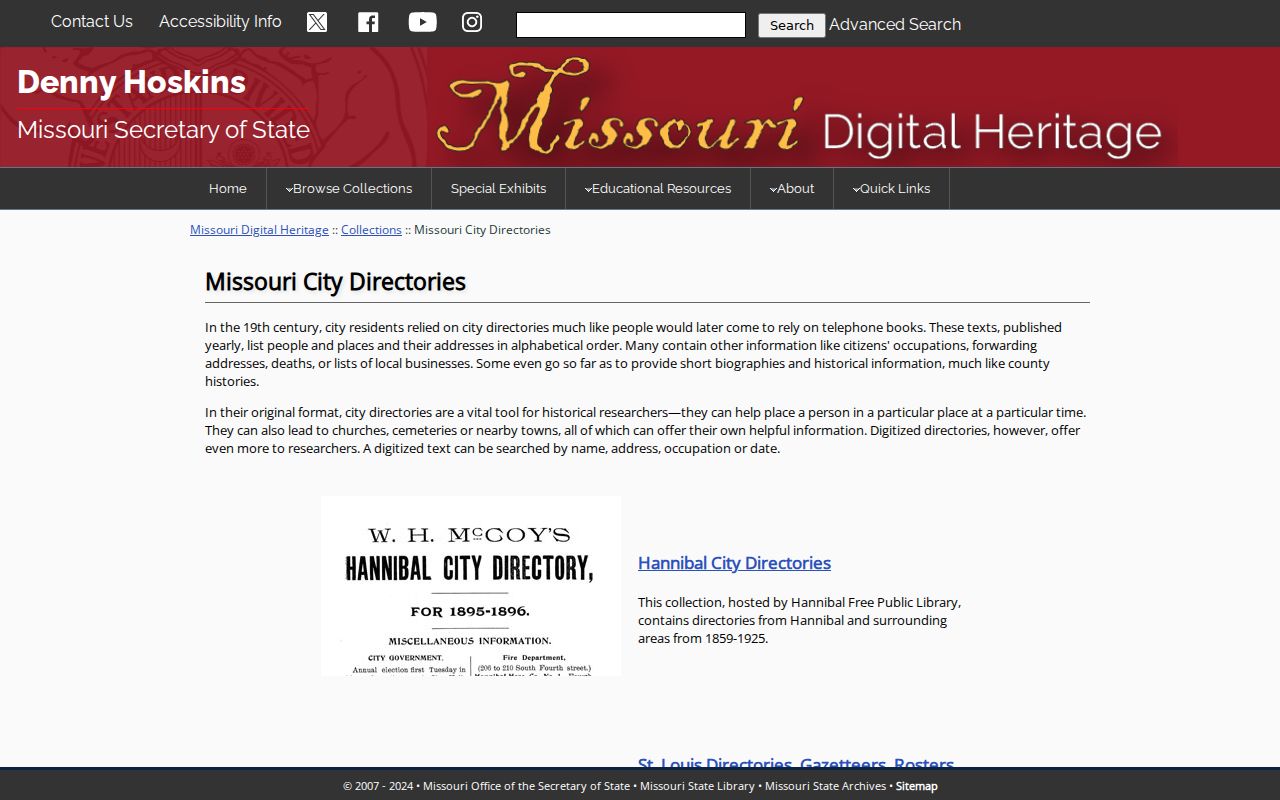
That statewide collection is a useful format reference while a Clay County researcher confirms whether a particular Liberty volume is held locally.
Clay County Archives and Newspaper Trails
Clay County Archives & Historical Library at 210 E. Franklin in Liberty holds original county records, family histories, photographs, school records, local newspapers, and local research publications. It is a practical place to test a directory address against school or newspaper context. Research is available on site or by correspondence. The Archives posts Monday through Wednesday hours of 9 to 4 and recommends calling on Monday before visiting because volunteer coverage is stronger on Tuesday and Wednesday.
Nonmembers pay $5 per day for on-site research. Correspondence begins at $10 per surname plus $10 for each additional research hour. The documented copy schedule includes $1 per page for original records, 25 cents for published black-and-white copies, 75 cents for color copies, 50 cents for oversized copies, and 25 cents for microfilm printouts. A current obituary-index title or complete year run was not verified, so ask staff to search the actual newspaper and historical materials rather than expecting an online name index.
The Archives research-services page describes correspondence access, copy charges, and research options.
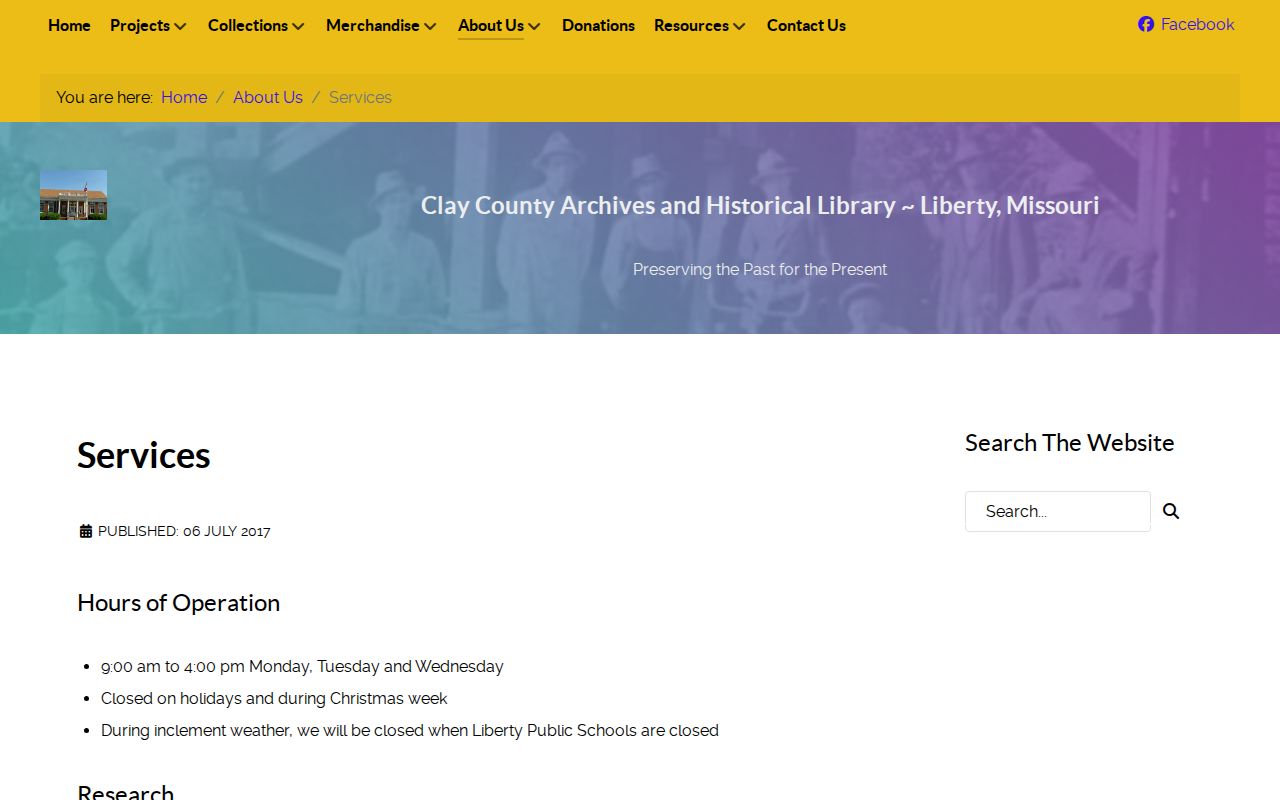
The Archives service route gives a Clay County directory search an alternative when a needed volume, newspaper item, or school record is not on an online index.
Clay County's 1934 Courthouse Story
The Clay County Historical Society formed in 1934 while preservationists tried to save the old courthouse. That same year, the second courthouse was razed. County offices temporarily used the Old Cockrell Building, while circuit-court work was held in the First National Bank basement and other county and probate offices occupied bank floors for about a year. A historical reference to one of those buildings can therefore reflect the temporary office shuffle rather than a missing record.
The current courthouse was constructed in the mid-1930s, and county sources identify a 1935 building. Surviving early records are still documented through archives and state finding aids, so the 1934 transition should not be treated as proof that every prior record disappeared.
Clay County Historical Society & Museum provides the local preservation context for the courthouse and its historical holdings.
The museum's local-history material can add place context to a historical Clay County address without replacing the directory, deed, or census evidence.
Trace Families with Clay County City Directories
Directory entries become stronger when they are read as a dated sequence. Start with a verified Liberty year, then move to the next verified volume or the closest available telephone book. Federal census schedules supply the household layer for released years, subject to the federal 72-year public-release rule. The national 1890 census loss leaves a major gap, where tax, church, probate, newspaper, and directory material may be more useful.
- Find the household's name in a verified Clay County directory volume or its nearest available companion source.
- Transcribe the line exactly, including the address and every abbreviation.
- Check the next available directory, phone book, or microform year for a move, spelling variation, or changed listing.
- Pair the address and family members with the nearest released federal census schedule.
- Use Clay marriage, probate, cemetery, and newspaper material to test a disappearance or family relationship.
FamilySearch's Clay marriage catalog and Clay probate catalog provide a deeper Clay County trail: marriage records and applications begin in 1822, while probate records cover 1822 to 1896 with indexes for 1868 to 1896. Those collections can connect spouses, heirs, guardians, and land without asserting that a person remained at the address later in life.
Clay County Directory Gaps and Companions
Midwest Genealogy Center's archival collections offer a useful fallback beyond old directory volumes. The Clay County, Missouri Marriages Scrapbook, Clay-focused vertical files, the Magill Family Bible, and the Joyce Kindred collection hold material such as family sheets, obituaries, census notes, cemetery information, circuit-court and deed records, and Liberty Tribune-Index copies. Archival material requires accepting the Rare Books and Archives Materials Use Policies, and some items have appointment or reproduction rules.
For a deceased resident, Liberty's cemetery GIS can search by last name or year of death, show a headstone location, and print a map. Mt. Memorial began as a public burying ground in 1836 and was officially named in 1916. Cemetery evidence helps close a historical trail, but it does not prove that anyone currently lives at an old address.
For a present-day parcel or a newer address record, use the Clay County street directory rather than trying to stretch a historical volume beyond its date.